
Quick answer
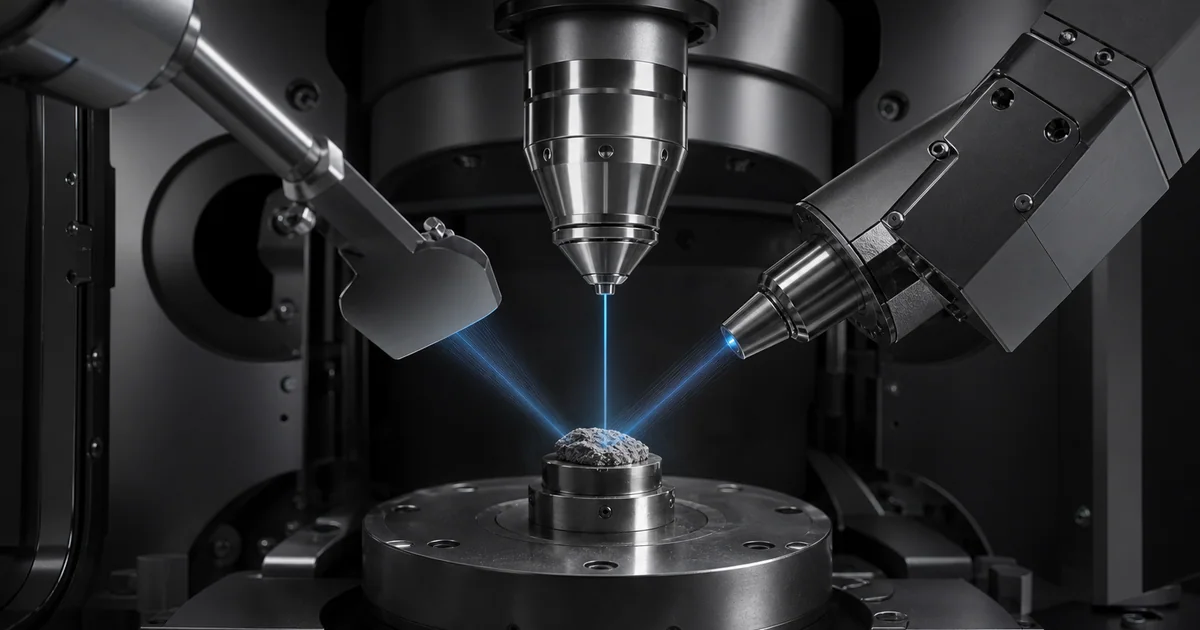
EDX and EDS are common names for energy dispersive X-ray spectroscopy in a scanning electron microscope. The technique measures characteristic X-rays emitted from the specimen after electron beam excitation.
The result can be a spectrum, point analysis, line scan, or elemental map. EDX is one of the most useful analytical tools attached to an SEM because it connects image features with elemental composition.
The important caution is simple: EDX identifies and estimates elements, but the quality of the answer depends strongly on acquisition conditions and sample preparation.
EDX vs EDS terminology
EDX and EDS are often used interchangeably.
| Term | Meaning | Common usage |
|---|---|---|
| EDX | Energy dispersive X-ray analysis or spectroscopy | Very common in Europe and instrument literature |
| EDS | Energy dispersive spectroscopy | Very common in microscopy and materials science |
| EDXA | Energy dispersive X-ray analysis | Older or formal variant |
On SemSip, EDX and EDS mean the same method unless a specific instrument vendor uses one term in a narrower way.
How EDX works
When the SEM electron beam enters the specimen, it can eject inner-shell electrons from atoms in the material. Electrons from higher energy shells then fill those vacancies. The energy difference is released as an X-ray with an energy characteristic of the element.
An EDX detector measures X-ray energy and counts. The software plots counts against energy. Peaks in the spectrum correspond to elements present in the interaction volume.
This is why EDX is elemental analysis, not molecular analysis. It can tell you that oxygen, silicon, aluminum, iron, or nickel are present. It does not directly tell you the chemical bonding state in the way XPS, EELS, Raman, or FTIR might.
What EDX is good for
EDX is excellent for:
- identifying unknown particles
- checking inclusions and contaminants
- comparing phases in alloys, ceramics, and rocks
- confirming coating composition
- mapping element distributions
- screening corrosion products
- supporting failure analysis
- selecting regions for more advanced analysis
It is especially powerful when combined with backscattered electron imaging. BSE can reveal contrast between phases, and EDX can test which elements explain that contrast.
What EDX is not good for
EDX is less reliable for:
- very light elements
- trace-level analysis
- very thin films on a thick substrate
- nanoscale particles smaller than the interaction volume
- rough, porous, or highly tilted surfaces
- distinguishing overlapping peaks without care
- proving oxidation state or molecular structure
The common beginner error is treating an automatically labeled spectrum as a final answer. Peak identification is a hypothesis that must be checked against physics, specimen history, and possible overlaps.
Interaction volume
EDX does not sample only the exact surface pixel visible in an SEM image. The electron beam creates an interaction volume inside the specimen. X-rays can come from a region that is larger and deeper than the visible surface feature.
The size of that region depends on:
- accelerating voltage
- material density and atomic number
- beam current
- specimen thickness
- sample tilt
- takeoff angle
For bulk materials, higher voltage usually increases X-ray generation depth. For small particles or thin coatings, that can mean the EDX result includes signal from the substrate as well as the feature of interest.
Accelerating voltage selection
A practical rule is that the beam energy should be high enough to excite the X-ray lines you need, but not so high that the interaction volume becomes larger than the feature you are analyzing.
For routine SEM-EDX, many analyses are performed in the 10 to 20 kV range. Lower voltages can improve surface sensitivity and reduce interaction volume, but may not excite higher-energy lines well enough. Higher voltages may improve counts for some elements but can mix signal from deeper material.
The right voltage depends on the element lines, specimen geometry, and analytical question.
EDX outputs
| Output | What it does | Best use |
|---|---|---|
| Spectrum | Counts vs X-ray energy | Identifying elements and checking peak quality |
| Point analysis | Spectrum from one selected point or small region | Comparing particles, inclusions, or phases |
| Line scan | Element counts along a line | Checking interfaces, diffusion zones, or coatings |
| Element map | Spatial distribution of selected elements | Visualizing phase distribution or contamination |
| Quant table | Estimated concentration values | Reporting composition with stated assumptions |
Quantification
EDX quantification can range from rough screening to carefully standardized analysis.
Unstandardized quantification can be useful for comparing similar regions in the same session. It should not be overclaimed as a high-accuracy chemical assay.
More rigorous quantification requires attention to:
- standards or standardless model limits
- background subtraction
- peak deconvolution
- absorption and fluorescence correction
- specimen flatness and polish
- carbon or metal coating contribution
- live time, dead time, and count statistics
Always report whether values are normalized, whether oxygen or carbon was included, and whether the analysis was standardless or standard-based.
Peak overlaps
Peak overlaps are one of the most important EDX interpretation problems. Different elements can produce X-ray lines at similar energies. Software can help separate them, but it can also make confident-looking mistakes.
When a peak overlap is possible:
- Check alternative lines for the same element.
- Compare the result with BSE contrast and sample history.
- Increase acquisition time if counts are poor.
- Use standards or complementary methods for critical claims.
- Avoid reporting trace-level elements from weak, overlapped peaks without evidence.
Sample preparation
Good EDX starts before the sample enters the SEM.
Flat, polished, conductive specimens are easier to quantify. Rough surfaces produce geometry effects because X-rays may be absorbed or emitted at different angles. Charging can destabilize the beam and degrade both imaging and spectra.
Coatings matter. Carbon coating is often preferred for EDX when a conductive coating is needed because metal coatings can add interfering peaks. If gold, platinum, palladium, chromium, or another coating is used, include it in the interpretation.
Practical SEM-EDX workflow
- Use SE imaging to locate the feature.
- Use BSE imaging to check for phase or atomic number contrast.
- Choose accelerating voltage based on target elements and feature size.
- Acquire a spectrum from the matrix or background.
- Acquire point spectra from features of interest.
- Confirm peak IDs manually, especially for overlaps.
- Use maps or line scans only after the spectrum proves the relevant peaks are usable.
- Report acquisition settings with the result.
What to report in methods
A useful SEM-EDX method section should include:
- SEM model and EDX detector type if known
- accelerating voltage
- beam current or probe current if available
- working distance
- detector takeoff geometry if relevant
- sample coating
- acquisition live time
- quantification method
- standards or standardless software
- whether results are normalized
This level of detail helps readers decide whether the EDX data supports the claim.
Bottom line
EDX or EDS is a fast, powerful elemental analysis method for SEM. It is ideal for connecting microstructure with chemistry, but it must be used with respect for interaction volume, peak overlaps, geometry, and quantification limits.
The best EDX results come from a combined workflow: image with SE, inspect phases with BSE, analyze with EDX, and report the conditions clearly.