
Subject
SEM Instruments and Buying Guides
Comparison pages for tabletop SEMs, full-size SEMs, lab requirements, used instruments, maintenance, and buying decisions.
Quick answer
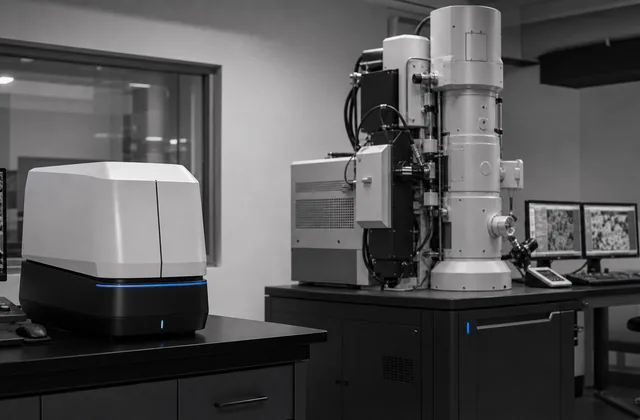
Tabletop SEMs are compact scanning electron microscopes designed for fast access, simpler operation, lower infrastructure burden, and routine imaging. Full-size SEMs are larger research or industrial platforms with stronger electron optics, more detector options, larger chambers, better analytical integration, and more experimental flexibility.
For many labs, the decision is not "Which one is better?" It is "Where should SEM capability live?" A tabletop SEM can make routine imaging available every day. A full-size SEM can answer harder research questions with better control.
Tabletop SEM vs full-size SEM comparison
| Category | Tabletop SEM | Full-size SEM |
|---|---|---|
| Best use | Routine imaging, teaching, quick checks, quality control | Advanced research, high-resolution imaging, analytical workflows |
| Typical access model | Near the bench, easier user training | Core facility or specialized lab |
| Resolution | Good for many micron-scale and some submicron tasks | Usually stronger, especially for nanoscale and low-kV work |
| Electron source | Often tungsten, LaB6, or compact field emission depending on model | Tungsten, LaB6, Schottky FE, or cold FE depending on configuration |
| Detector flexibility | Limited but improving | Broad detector options and custom geometry |
| Chamber size | Smaller samples and simpler holders | Larger samples, tilting, stages, accessories |
| EDX capability | Often available for routine elemental analysis | Stronger analytical geometry and higher configurability |
| EBSD capability | Uncommon or limited | Common on research and materials platforms |
| Vacuum modes | Model dependent, often simplified | High vacuum, low vacuum, variable pressure, or environmental options |
| Training burden | Lower | Higher |
| Infrastructure | Lower space and facility demands | Greater facility, vibration, power, gas, and service needs |
| Cost | Lower purchase and operation cost in many cases | Higher purchase, service, and configuration cost |
| Main advantage | Accessibility | Capability |
| Main limitation | Less flexibility | More complexity and cost |
Key takeaways
- A tabletop SEM is often the fastest way to add SEM imaging capacity.
- A full-size SEM is better when the lab needs maximum resolution, detector flexibility, advanced analysis, or unusual sample handling.
- Tabletop instruments are not toys. They can produce serious data when used within their limits.
- Full-size instruments are not automatically better for every workflow. Queue time, training load, and sample logistics can reduce practical value.
- Many successful facilities use both: tabletop SEM for triage and routine work, full-size SEM for demanding research.
What tabletop SEMs do well
Tabletop SEMs are designed around access. They shorten the path from question to image. A student, quality engineer, or researcher can often load a sample and obtain a useful image with less setup than on a full research instrument.
Strong use cases include:
- Teaching SEM fundamentals
- Inspecting particles, fibers, powders, and fractures
- Checking coatings and surface morphology
- Screening samples before full SEM or FIB work
- Production quality control
- Failure analysis triage
- Basic EDX screening
- Supporting labs without a dedicated microscopy core
The biggest operational value is that a tabletop SEM can reduce dependence on a central queue. If every simple imaging request goes to a full-size SEM, the research instrument becomes a bottleneck. A tabletop system can absorb routine demand.
What full-size SEMs do well
Full-size SEMs are built for capability and flexibility. They usually provide better column performance, more stable stages, more chamber ports, more detectors, more sample geometry options, and stronger integration with EDX, EBSD, cathodoluminescence, in situ stages, or cryo workflows.
Strong use cases include:
- High-resolution nanomaterials imaging
- Low-voltage surface-sensitive SEM
- Semiconductor inspection
- EBSD for crystallographic orientation
- Advanced EDX mapping
- Large or irregular samples
- Beam deceleration
- Variable pressure or environmental workflows
- Publication-grade images from difficult specimens
- Shared core facility service
The full-size SEM is the better choice when users need to control the experiment, not just capture a quick image.
Resolution and image quality
Tabletop SEM resolution has improved significantly, especially in higher-end compact systems. For many practical questions, the image quality is more than adequate. A tabletop SEM may clearly show particle morphology, fracture features, contamination, insect structures, fibers, corrosion products, and additive manufacturing powders.
The difference becomes important when the research question involves small features, low accelerating voltage, beam-sensitive samples, or subtle surface contrast. Full-size field emission SEMs tend to outperform compact instruments in these areas because they have more advanced electron optics, stronger source options, and better detector geometry.
Users should avoid comparing only ideal resolution numbers. A better test is to image the actual sample at the voltage, working distance, detector mode, and preparation level expected in daily use.
EDX and analytical capability
Many tabletop SEMs can be equipped with EDX. This makes them useful for routine elemental identification, contamination checks, and screening. For example, a quality control lab may use tabletop SEM-EDX to identify metal particles, mineral inclusions, or coating defects.
Full-size SEMs are usually stronger for demanding analytical work. They may support larger EDX detectors, better takeoff geometry, higher stable probe current, EBSD, WDS, cathodoluminescence, or combined analytical workflows. They also offer more control over stage tilt, working distance, beam current, and detector positioning.
For quantitative or publication-critical microanalysis, a full-size analytical SEM is often the safer choice.
Sample size and handling
Tabletop SEMs have smaller chambers. That is acceptable for prepared mounts, small coupons, powders, filters, insects, fibers, and compact components. It becomes limiting for large industrial parts, awkward fracture surfaces, cross sections in custom holders, tilted EBSD samples, heating stages, tensile stages, cryo transfer, or air-sensitive transfer systems.
Full-size SEMs offer more room. They can support larger stages, motorized axes, sample tilt, multiple detectors, and specialized accessories. If the lab routinely studies real-world parts rather than small prepared specimens, chamber geometry may matter more than nominal resolution.
Workflow and training
Tabletop SEMs are attractive because they lower the training barrier. Their software often guides users through pumpdown, focus, brightness, contrast, and image capture. This is helpful in teaching labs and multi-user environments.
Full-size SEMs require more skill, but they also reward it. An experienced operator can tune accelerating voltage, probe current, aperture, working distance, detector mix, scan strategy, and sample preparation to extract much more information.
The management question is simple: should the instrument serve many users with routine needs, or fewer users with advanced requirements?
Cost and facility planning
Tabletop SEMs usually reduce:
- Floor space
- Installation complexity
- Training time
- Service burden
- Queue pressure
- Cost per routine image
Full-size SEMs usually increase:
- Capability
- Detector options
- Analytical performance
- Upgrade paths
- Sample accommodation
- Long-term research scope
The financial comparison should include not only purchase price, but also service contracts, EDX software, consumables, coating equipment, staff time, room preparation, vibration control, nitrogen or compressed air needs, and productivity gained from faster access.
Best decision model
Choose tabletop SEM when:
- The lab needs fast routine imaging.
- Samples are small and relatively simple.
- Users are students, quality technicians, or occasional SEM operators.
- The primary questions are morphology, defects, particles, and screening.
- Budget or facility constraints limit full-size SEM ownership.
Choose full-size SEM when:
- Research requires high resolution or low-voltage performance.
- The lab needs advanced detectors or analytical techniques.
- Samples are large, tilted, air-sensitive, heated, cooled, or mechanically tested.
- EBSD or high-quality EDX mapping is important.
- The instrument must support many evolving research programs.
Choose both when:
- A core facility has routine overload.
- A production team needs quick triage but still depends on expert analysis.
- A university wants broad student access without sacrificing advanced research capability.
Practical buying advice
Do not buy a tabletop SEM because it looks simple. Buy it because its limits match the work. Do not buy a full-size SEM because it looks prestigious. Buy it because the lab will use the additional control.
The best procurement process includes a representative sample day. Bring easy samples, hard samples, charging samples, and analytical samples. Ask each vendor to show normal workflow, not only the best image they can produce after long tuning.
The winning instrument is the one that produces useful data at the speed, skill level, and reliability your lab can sustain.
Where to go next
A short editorial reading list. Pick whichever fits how you like to learn.
- Royal Microscopical Society: professional microscopy community and education
- Microscopy Society of America: society resources, meetings, and microscopy community