
Subject
SEM Basics
Plain, accurate introductions to scanning electron microscopy, SEM imaging, resolution, magnification, vacuum, and SEM vs TEM.
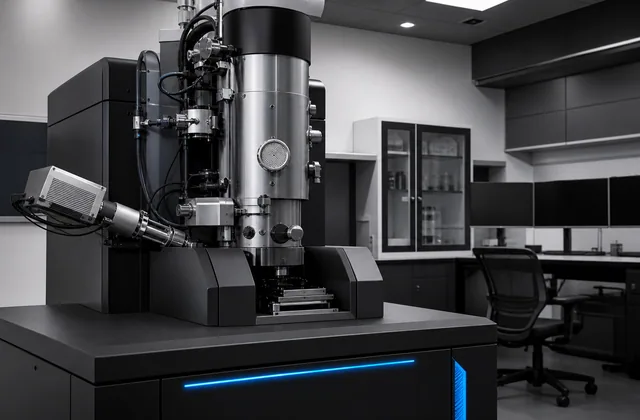
Quick answer
Scanning electron microscopy, usually shortened to SEM, is a method for imaging tiny structures by scanning a focused beam of electrons across a sample. The instrument detects signals produced where the beam interacts with the sample, then converts those signals into a high detail grayscale image.
SEM is best known for crisp surface images with strong depth of field. It can reveal cracks, pores, fibers, grains, coatings, biological textures, particles, and manufactured features at scales that are difficult or impossible to study with ordinary optical microscopes.
Key takeaways
- SEM uses electrons rather than visible light, which allows much finer spatial detail than conventional light microscopy. (For the underlying wave-particle physics, see Feynmanpedia's The Double-Slit Experiment.)
- The image is built by scanning the beam point by point across the sample.
- Secondary electrons are commonly used for surface topography.
- Backscattered electrons are commonly used for atomic number contrast and phase differences.
- SEM can often be combined with EDX or EDS to identify elements in the sample.
- Most SEM work requires a vacuum chamber and careful sample preparation.
What SEM means
The name describes the method:
- Scanning: the beam moves across the sample in a controlled raster pattern.
- Electron: the probe is a beam of accelerated electrons, not light.
- Microscopy: the result is an image or analytical measurement of small structures.
In practical terms, SEM is a bridge between imaging and microanalysis. A user can inspect surface shape, compare regions, measure features, document defects, and, with the right detectors, gather chemical or crystallographic information.
What SEM is good at
SEM is especially strong when the question is about surface detail.
Common examples include:
- How rough is this coating?
- Are there cracks on this fracture surface?
- What shape are these particles?
- Are fibers broken, fused, or contaminated?
- Does this insect eye show regular compound lens structure?
- Is a semiconductor feature malformed or contaminated?
- Are different mineral phases visible in the same polished section?
This is why SEM appears in research laboratories, failure analysis labs, industrial quality control, universities, hospitals, museums, and forensic facilities.
What an SEM image represents
An SEM image is not a photograph in the ordinary sense. It is a map of signal intensity.
At each point on the scanned surface, the electron beam interacts with the sample. Some interactions release secondary electrons, some scatter beam electrons back out of the sample, and some produce X-rays. Detectors collect these signals and assign brightness values to image pixels.
Because the brightness depends on signal type, sample geometry, composition, and instrument settings, SEM images must be interpreted with context. A bright region might mean a surface edge, a tilted feature, a heavy element, or a charging artifact, depending on the detector and operating conditions.
Main SEM signals
Secondary electrons
Secondary electrons come from the near surface of the sample. They are widely used for topographic imaging because edges, ridges, pores, and fine textures often appear with strong contrast.
Secondary electron images are the classic SEM look: highly detailed, three dimensional in appearance, and excellent for surface morphology.
Backscattered electrons
Backscattered electrons are beam electrons that leave the sample after elastic scattering. Heavier elements generally backscatter more strongly, so backscattered electron images can show compositional contrast.
In a polished materials sample, a heavy element phase may appear brighter than a lighter element phase. This makes backscattered imaging useful for metals, ceramics, geological samples, and multiphase materials.
Characteristic X-rays
When the beam interacts with atoms in the sample, the sample can emit characteristic X-rays. EDX or EDS detectors measure those X-rays to estimate which elements are present.
EDX does not replace careful chemistry, but it is one of the most useful SEM add-ons for practical microanalysis.
Why SEM has high depth of field
SEM images often look almost sculptural because many surfaces remain visually sharp at once. This high depth of field is one of the main reasons SEM is popular for complex surfaces such as insect eyes, fracture faces, porous membranes, and powders.
The effect comes from the small beam probe and the way the image is formed by scanning. It allows researchers to see relationships between features that would be difficult to keep in focus with optical microscopy at similar magnification.
Typical SEM samples
SEM can examine many materials, including:
- Metals and alloys
- Ceramics and minerals
- Polymers and fibers
- Semiconductor devices
- Biological specimens
- Insects and plant surfaces
- Powders, nanoparticles, and particles
- Coatings, films, and corrosion products
The exact preparation depends on the sample. Conductive materials are often simpler. Nonconductive samples may need coating, low vacuum imaging, charge reduction, or specialized mounting.
What SEM cannot do by itself
SEM is powerful, but it has limits.
It does not automatically identify every material. It does not show true natural color. It may not image deeply inside a bulk object unless the sample is sectioned, fractured, polished, or milled. It can damage sensitive samples if the beam energy, current, or exposure is too high.
SEM also requires interpretation. Instrument settings, detector choice, sample preparation, and artifacts can all influence the image.
SEM compared with other microscopy methods
Compared with optical microscopy, SEM offers higher magnification, better surface detail, and much greater depth of field. Optical microscopy is faster, cheaper, and better for color and live specimens.
Compared with transmission electron microscopy, SEM is usually easier for surface imaging and larger samples. TEM can reach higher resolution and reveal internal structure, but it requires very thin samples and more demanding preparation.
Compared with atomic force microscopy, SEM provides fast visual context over larger areas. AFM can measure surface height with extreme precision, but it is slower and more limited in field of view.
Why SEM matters
SEM matters because many scientific and industrial problems are surface problems. Failure often begins at cracks, inclusions, pores, grains, interfaces, fibers, or contamination sites. SEM gives researchers a way to inspect those features directly.
For a researcher, SEM can turn a vague sample problem into observable evidence. For a manufacturer, it can explain defects. For a student, it can make the microscopic structure of the world visible. For a science communicator, it can show unfamiliar landscapes in everyday objects.
Practical interpretation tips
When reading or publishing an SEM image, always look for:
- Detector type
- Accelerating voltage
- Working distance
- Magnification or scale bar
- Sample preparation method
- Coating material, if used
- Vacuum mode
- Whether the image is raw, processed, or colorized
These details make the difference between a striking image and a useful scientific record.
Related SEM terms
- Secondary electron imaging
- Backscattered electron imaging
- EDX or EDS microanalysis
- Working distance
- Accelerating voltage
- Beam current
- Charging
- Sputter coating
- Field emission SEM
- Tabletop SEM
Where to go next
A short editorial reading list. Pick whichever fits how you like to learn.
- Royal Microscopical Society: professional microscopy community and education
- Microscopy Society of America: society resources, meetings, and microscopy community