
Quick answer
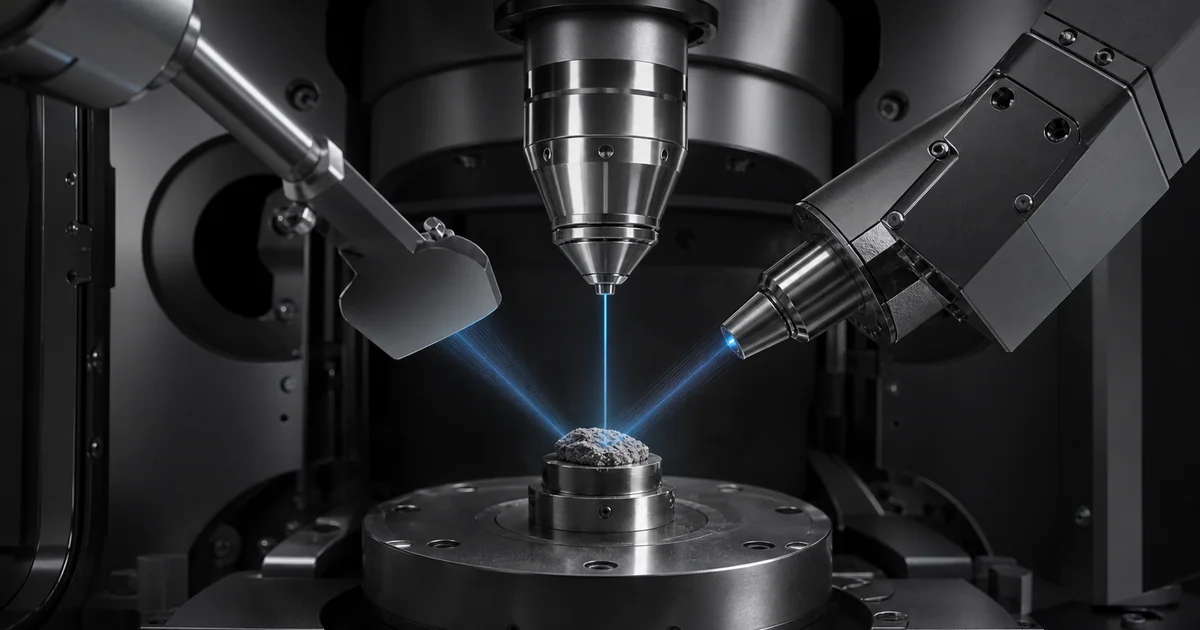
An in-lens detector is a secondary electron detector built into or near the SEM electron column. It uses the instrument's electrostatic and magnetic fields to collect low-energy electrons that travel back toward the column.
In practice, in-lens detection is used when the operator wants high-resolution, surface-sensitive imaging. It is common on field emission SEM systems and is especially valuable for low-voltage imaging of fine structures.
What an in-lens detector collects
In-lens detectors usually favor secondary electrons generated close to the beam impact point. That means the image is often SE1-rich and strongly tied to fine surface detail.
The exact signal depends on the SEM design. Some instruments use the term "in-lens," others use "through-the-lens," "upper detector," or vendor-specific names. The engineering details vary, but the practical idea is similar: collect surface-sensitive signal close to the optical axis instead of relying only on a chamber-mounted detector.
Why in-lens images look different
Compared with a chamber secondary electron detector, an in-lens image often looks cleaner, sharper, and less shadowed. It may show nanoscale surface texture that is muted or blurred in a conventional SE image.
This happens because the detector geometry reduces some chamber-dependent SE2 contribution and collects a signal that is more local to the beam position.
The tradeoff is that in-lens images can look flatter or less visually dramatic than Everhart-Thornley images. For some specimens, that is a benefit. For others, the chamber detector gives a more intuitive shape overview.
Best use cases
In-lens detection is especially useful for:
- nanoparticles and nanostructured surfaces
- thin films and coatings
- semiconductor patterns
- polymer surfaces at low voltage
- surface contamination and residues
- fine fracture texture
- delicate samples where lower landing energy is preferred
It is also helpful when you need to compare subtle surface changes across processing conditions, such as plasma treatment, coating thickness, etching, sintering, or corrosion.
Comparison with chamber SE detection
| Feature | In-lens detector | Chamber SE detector |
|---|---|---|
| Signal tendency | SE1-rich, surface-local | Mixed SE1 and SE2, often stronger topographic shadowing |
| Best working distance | Short | Flexible, often medium to long |
| Strength | Fine detail and high resolution | Navigation and intuitive topography |
| Common instrument type | Field emission SEM | Many SEM types |
| Rough sample behavior | Can be less intuitive | Often easier to read |
| Low-voltage performance | Often excellent | Depends strongly on geometry and detector design |
Working distance matters
In-lens detectors usually perform best at short working distance because the column field can collect emitted electrons efficiently and the probe size can remain small.
At longer working distance, the in-lens signal may weaken, become less consistent, or lose the advantage that made it useful. If the sample must be far from the pole piece because of height, tilt, EDX geometry, or an accessory stage, a chamber detector may be more practical.
Low-voltage SEM and surface sensitivity
In-lens detection pairs well with low accelerating voltage. Lower beam energy reduces the interaction volume and increases surface specificity. That can be valuable for thin coatings, beam-sensitive materials, and samples where charging must be controlled.
The operator still needs to manage signal-to-noise ratio. Low voltage can reduce beam penetration and damage, but it can also reduce available signal. A field emission source, stable stage, clean vacuum, and careful scan settings become more important.
Practical selection guidance
Use in-lens detection when the question is about surface texture at fine scale. If you are looking for nanoscale roughness, particle boundaries, coating continuity, or residue, in-lens is often the best first serious image mode.
Use a chamber SE detector first when the sample is large, rough, tilted, or unfamiliar. It will often make it easier to navigate and understand the three-dimensional shape.
Use BSE when the question is composition rather than topography. In-lens secondary electron imaging is not a substitute for compositional imaging or microanalysis.
Common limitations
The first limitation is sample geometry. Tall or rough samples may not sit at the working distance where the in-lens detector performs best.
The second limitation is charging. Since secondary electrons are low energy, local fields from insulating samples can distort contrast and reduce interpretability.
The third limitation is overinterpretation. A sharp in-lens image can look authoritative, but brightness still depends on surface angle, material, contamination, beam conditions, and detector field.
Practical imaging workflow
- Navigate with a chamber SE detector at low magnification.
- Move to the region of interest and reduce working distance if the instrument and sample allow it.
- Switch to in-lens detection and optimize focus, stigmation, and scan speed.
- Adjust landing energy to balance surface sensitivity, charging, and signal.
- Capture a paired chamber SE or BSE image if the interpretation depends on shape or composition.
In-lens vs through-the-lens terminology
The terms are sometimes used loosely. A through-the-lens detector generally collects electrons through the objective lens or column field. An in-lens detector is commonly understood as a detector integrated into the lens or column system.
For users, the important point is not the label. The important point is the signal preference and geometry. Ask what signal the detector emphasizes, what working distance it requires, and how it behaves at the beam energy used for the experiment.
Bottom line
In-lens detectors are among the most useful tools for high-resolution SEM surface imaging. They are not a universal replacement for chamber SE or BSE detectors, but they are often the cleanest route to fine topographic information.
For rigorous work, document the detector name, working distance, voltage, probe current, tilt, and scan conditions. In-lens images are most valuable when the detector choice is visible in the method, not hidden as an unnamed default.